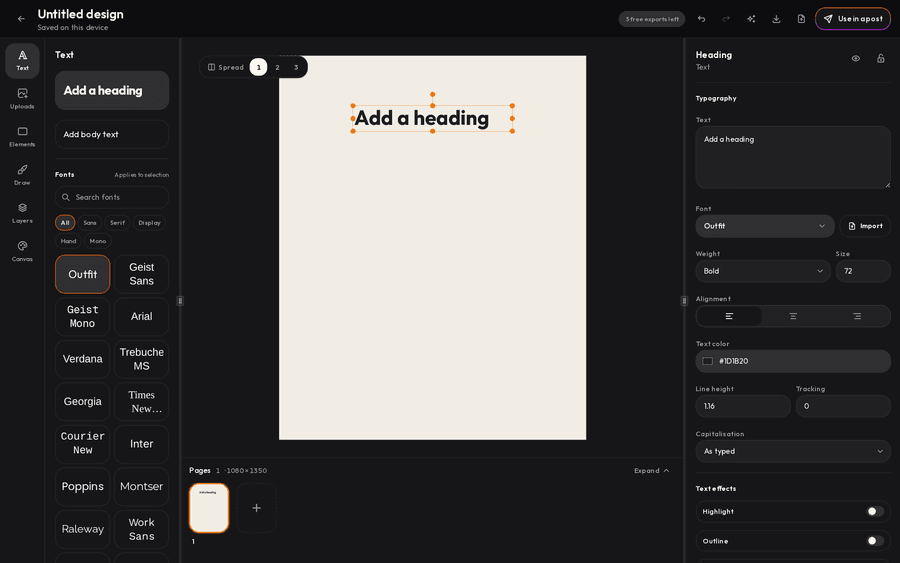
Stencil
2026A local-first, open-source visual editor for social graphics, carousels and video scenes, built so people and AI agents can edit the same structured design. Extracted from the editor I built inside Sociona.
KovrPay · 2026
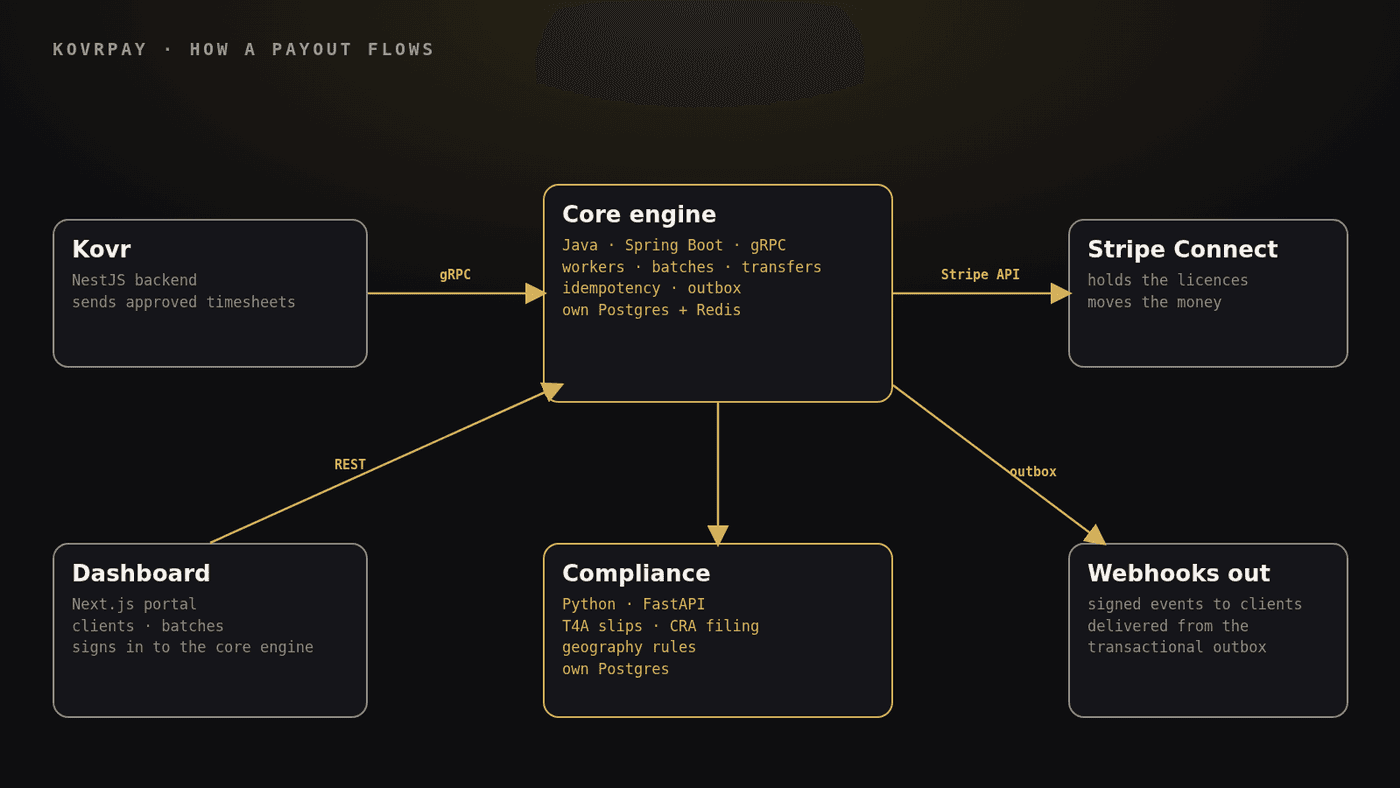
Contractor payout infrastructure for shift platforms in Canada. KovrPay orchestrates worker onboarding, batch payroll, T4A slips and CRA filing, while Stripe Connect holds the licences and moves the money. Built as KOVR's own payments layer, with a Java core, a Python compliance service and a Next.js portal.
read the case study ↓Shift and gig platforms need to pay contractors correctly and prove it. In Canada that means onboarding each worker, funding a payout, moving the money in batches, and later issuing T4A slips and filing with the CRA. KovrPay packages all of that so a platform integrates once and does not build payroll plumbing of its own.
Stripe holds the banking licences. KovrPay owns onboarding state, batch execution, webhooks and tax documents. Building everything else yourself is realistic. Building a money transmitter is not.
Payroll begins only when a shift exists, attendance is recorded, time is approved and the amount is final. The boundary with KOVR is approved timesheets, not job postings.
Every request carries an idempotency key, webhooks are de-duplicated, and events leave through a transactional outbox so nothing is lost or sent twice.
Jurisdictions and rule sets live in the database, so adding a province or a rate change is not a deploy.
KOVR is client number one and goes through the same API as anyone else, which keeps the public surface honest.

Payment processors move money and leave the rest to you. Payroll suites are built for employees on a payroll, not a stream of contractors on one-off shifts. Staffing platforms often hand payouts to a third-party vendor.
 Java 25 + Spring BootThe core engine: workers, batches, transfers, outbox
 Python + FastAPIThe compliance service: T4A slips and CRA filing
 PostgreSQL + FlywayA database per service, with versioned migrations
 RedisIdempotency, rate limiting and webhook de-duplication
 Stripe ConnectWorker payout accounts and the money movement
 Next.jsThe client portal
 Docker + RailwayLocal infrastructure and three deployable services
Idempotency keys on requests, de-duplicated webhooks, and a transactional outbox so each event is stored with the change that caused it and delivered until acknowledged.
Jurisdictions and rule sets are loaded as data at start-up, with a bootstrap that initialises them, instead of being scattered through the code.
A Docker set-up for local infrastructure, a database created per service on start, and a clean-checkout pass that fixed the build and the container setup.
The integration plan gives KOVR ownership of shifts, attendance and approvals, and KovrPay ownership of payout accounts, batches and tax documents, with a small contract between them.
KovrPay runs as three services with a sandbox payout flow. It is not processing real payroll. These numbers describe what was built.
Built for KOVR first. Stripe moves the money; KovrPay handles everything around it. Sandbox only, not live.
KovrPay is the payments layer behind KOVR, the shift marketplace.
A local-first, open-source visual editor for social graphics, carousels and video scenes, built so people and AI agents can edit the same structured design. Extracted from the editor I built inside Sociona.
Want something like KovrPay?
Tell me what you're making and I'll tell you how I'd build it.